

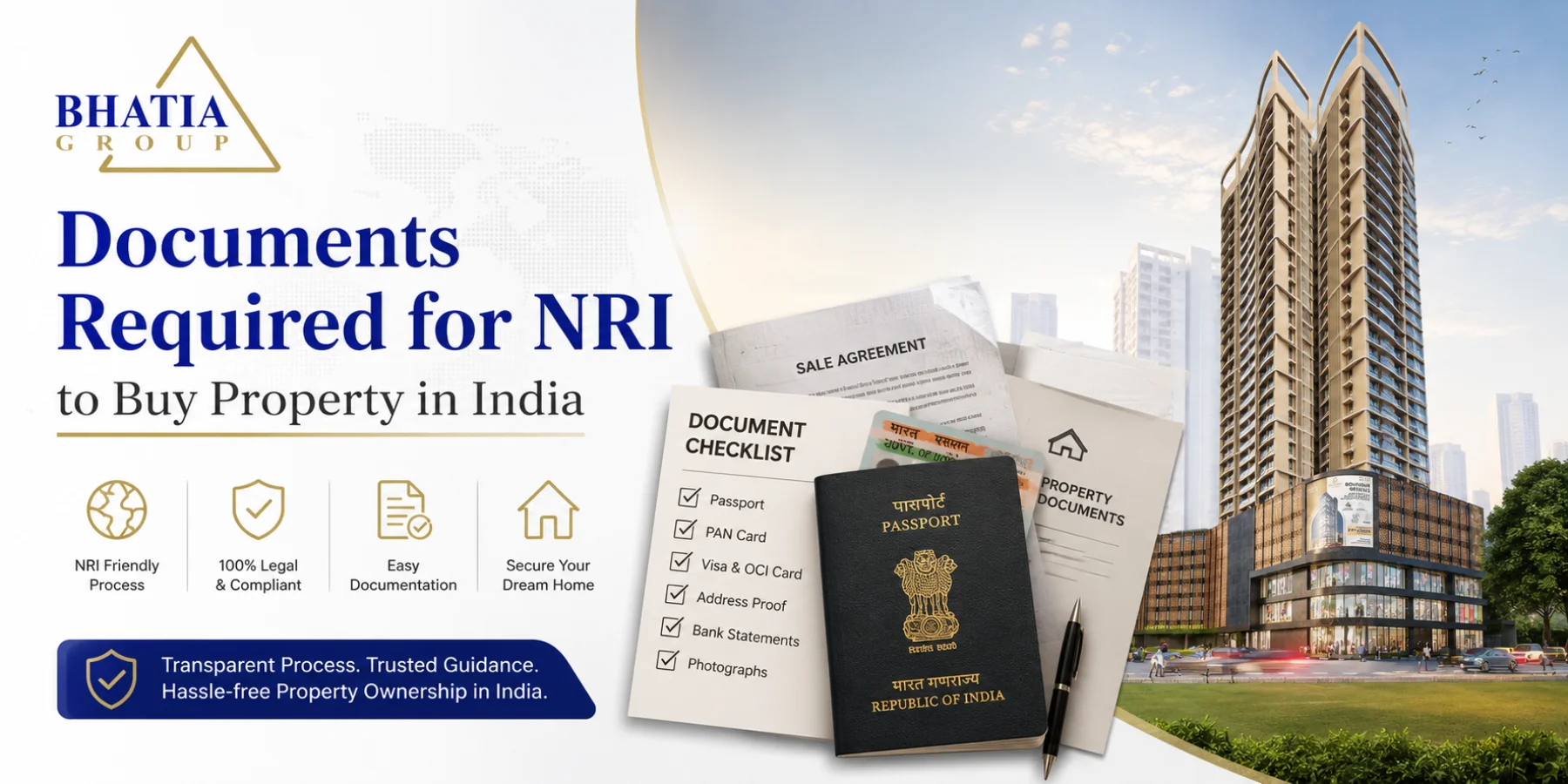
If you're an NRI dreaming of owning a home back in India, the excitement often fades the moment paperwork enters the picture. Between embassy attestations, PAN cards, and bank account rules, it's easy to feel lost before you've even shortlisted a property. The truth is, buying property in India as an NRI isn't complicated once you know exactly what's needed and when. Whether you're purchasing for family use, rental income, or long-term NRI real estate investments, having the right documents ready from the start can save you weeks of delay. This guide walks you through every document required for an NRI to buy property in India, plus the procedure that ties it all together, so your purchase stays smooth, compliant, and stress-free.
Who Qualifies as an NRI Buyer?
Under the Foreign Exchange Management Act (FEMA), an NRI is an Indian citizen residing outside India for employment, business, or any purpose indicating an extended stay abroad. The same buying rights generally extend to OCI (Overseas Citizen of India) cardholders and PIOs (Persons of Indian Origin). One important restriction applies across the board: NRIs cannot purchase agricultural land, farmhouses, or plantation property in India, these remain reserved for resident Indians, except when acquired through inheritance.
Documents Required for NRI to Buy Property in India
This is the part most buyers search for first, so let's get straight to it. Here's the complete checklist, grouped by category.
1. Identity and Residency Documents
- Valid Passport – Indian passport, or foreign passport along with a valid OCI/PIO card
- Visa or Residence Permit – work visa, student visa, or equivalent, showing current overseas status
- PAN Card – mandatory for registration, TDS compliance, and filing returns if the property is later rented or sold
- Overseas Address Proof – a recent utility bill, foreign bank statement, or driving licence
2. Banking and Financial Documents
All payments must route through proper banking channels, cash or foreign currency payments aren't accepted for property transactions in India.
- NRE/NRO Bank Account – at least one of these is mandatory to fund the purchase
- Last 6 months' bank statements – from both Indian NRE/NRO accounts and your overseas salary account
- Income proof – salary slips, employer letter, or business financials for self-employed buyers
- Income Tax Returns – particularly important if applying for a home loan
3. Property-Related Documents
- Sale Agreement / Sale Deed – the core contract establishing the transaction terms
- Title Deed – confirms the seller's legal ownership
- Encumbrance Certificate (EC) – verifies the property carries no pending loans, disputes, or legal claims
- RERA Registration Details – confirms the project is registered with the Real Estate Regulatory Authority
- Approved Building Plan and Occupancy Certificate – for ready or near-completion projects
4. Power of Attorney (PoA), If Buying Remotely
Most NRIs cannot be physically present in India for every step, booking, loan processing, and registration. A Power of Attorney solves this by authorising a trusted person in India to act on your behalf.
A few things to get right here:
- It must be a Special Power of Attorney, clearly listing the permitted actions, general POAs are typically not accepted for registration
- It needs to be signed before a notary or consular officer in your country of residence
- It must then be attested or apostilled by the Indian Embassy/Consulate (apostille for Hague Convention countries like the US, UK, Canada, and Australia)
- Self-attested documents are not accepted anywhere in this process
Skipping proper attestation is one of the most common reasons NRI property files get stuck at the Sub-Registrar's office.
Procedure for NRI to Buy Property in India
Once your documents are ready, the process follows a fairly predictable sequence:
-
Define your requirement – residential or commercial, ready-to-move or under construction, and budget
-
Shortlist and verify the property – check title, RERA status, and Encumbrance Certificate before booking
-
Arrange funds – through your NRE/NRO account or inward remittance from abroad
-
Apply for a home loan, if needed – major banks like SBI, HDFC, ICICI, and Axis run dedicated NRI desks
-
Execute the Sale Agreement – in person or through your PoA holder
-
Pay stamp duty and registration fees – calculated on the higher of the agreement value or Ready Reckoner rate
-
Register the Sale Deed – at the local Sub-Registrar's office, with biometric verification of all parties
-
Complete mutation – so revenue records reflect your name for tax and ownership purposes
For buyers in Mumbai, this means engaging with the Sub-Registrar's office under Maharashtra's Department of Registration and Stamps. Stamp duty currently stands at around 6% for male buyers and 5% for female buyers (including the 1% Metro Cess), calculated on whichever is higher, agreement value or Ready Reckoner rate. Registration charges add roughly 1%, capped at ₹30,000 for properties above ₹30 lakh. Rates are revised periodically, so confirm current figures before finalising your budget. Want to know more about what to check in RERA before buying an under-construction project?
A Quick Reference
| Document Category | Key Documents | Mandatory? |
|---|---|---|
| Identity | Passport, OCI/PIO card, Visa | Yes |
| Tax | PAN Card | Yes |
| Banking | NRE/NRO account, bank statements | Yes |
| Authorisation | Special Power of Attorney (attested) | Only if buying remotely |
| Property | Title Deed, EC, RERA details | Yes |
| Loan (if applicable) | ITRs, salary slips, credit report | Only for financed purchases |
Common Mistakes to Avoid
- Skipping the Encumbrance Certificate, which can hide pending loans or disputes
- Using a general (rather than special) Power of Attorney for registration
- Paying through channels other than NRE/NRO accounts or proper remittance
- Forgetting that repatriating sale proceeds later needs Form 15CA/15CB and is capped at USD 1 million per financial year from an NRO account.
Final Thoughts
Buying property in India as an NRI is entirely manageable once your documentation is organised early, ideally before you even start shortlisting properties. Banks, developers, and the Sub-Registrar's office will each ask for slightly different combinations of these papers at different stages, so having them ready in advance saves weeks of back-and-forth.
At Bhatia Builders, we work with NRI buyers regularly and understand exactly which documents matter at each step, from booking to final registration. Our dedicated NRI Corner offers real estate solutions for NRI buyers, including personalised guidance on documentation, RERA-approved projects, and remote transaction support, and assistance for safe NRI real estate investments, so the process stays smooth even if you can't be in India in person.
Related Posts
Why Esspee Square is a "Safe Haven" Asset for NRI Commercial Investors
Why is Borivali Becoming the Top Choice for NRI Real Estate Investment?