

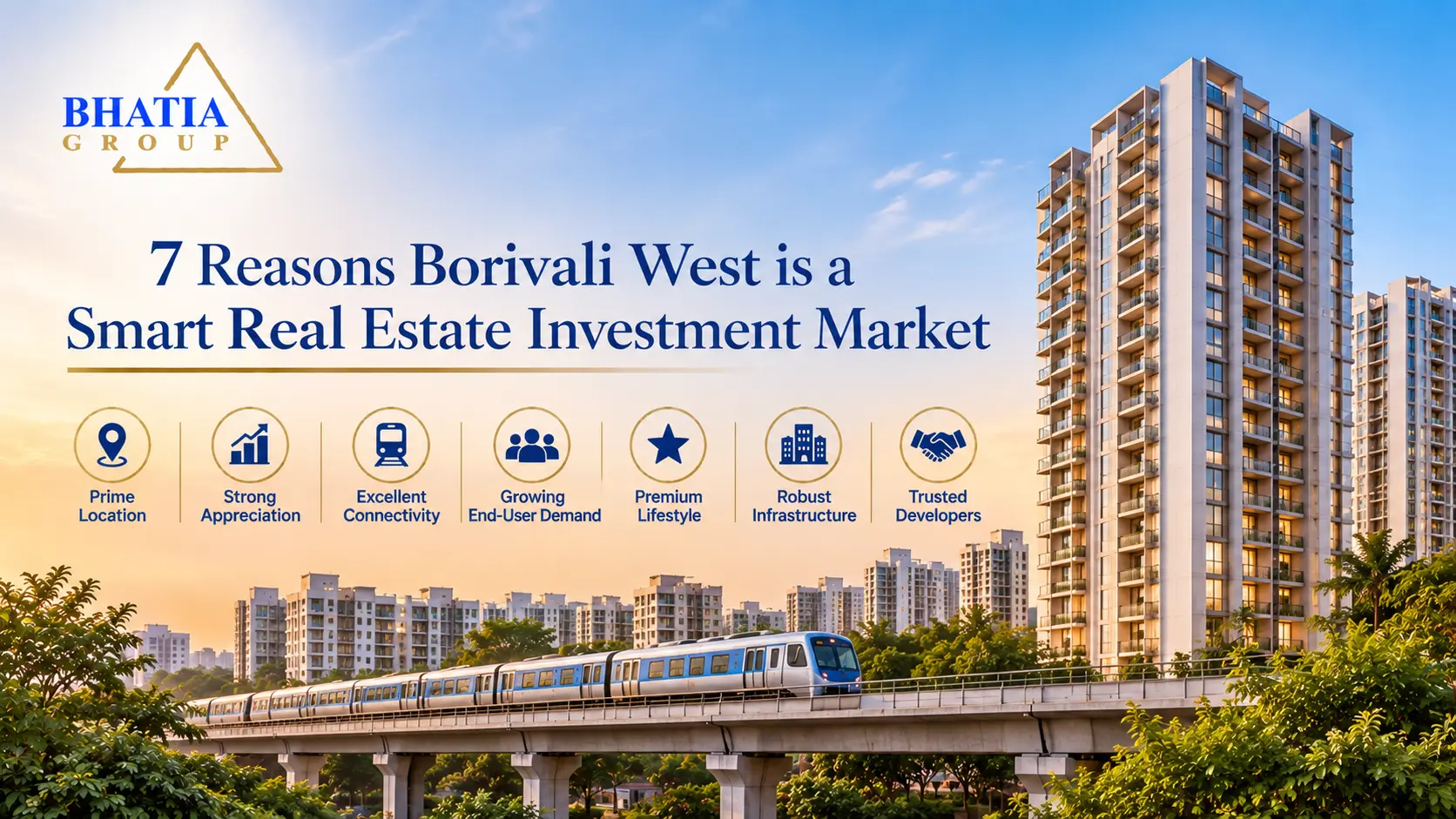
Investors look at Borivali West for seven reasons: steady end-user demand, rail and metro access, a planned road link to Thane, a choice of projects, exit options, manageable holding costs and a verifiable developer record. Each reason has a risk behind it, such as high entry cost, project delays or slow resale. No one can promise returns, so treat these as signals to check, not guarantees.
"Smart" in real estate does not mean "guaranteed." It means choosing with open eyes. If you are weighing the Borivali West investment market against other parts of Mumbai, the most useful approach is to look at each strength together with its risk. This guide gives you seven signals investors commonly watch, and for each one, what could go wrong and what to check.
Check 1: Is there a steady demand base?
Borivali West has long been a residential neighbourhood where many families live for years. That kind of end-user base can support steady demand for homes, because people buy to live rather than to flip. Our piece on whether this is Mumbai's next premium micro-market looks at the growth angle in detail.
Risk: Steady demand does not mean rising prices. Popular pockets can already be priced high.
Check: Compare asking prices of three similar projects on the same street or nearby.
Check 2: Are transport links in place?
The area sits on the Western Railway line, and Metro Line 2A has a station at Borivali West. Metro Line 9 (Phase 1, Dahisar East to Kashigaon) was inaugurated in April 2026. Good transport can make a home easier to live in and easier to rent or sell.
Risk: A station that looks close on a map may still be a long walk. Crowding at peak hours is also common.
Check: Time the actual trip from the project to the nearest station at rush hour.
Check 3: What about the Thane–Borivali tunnel?
The twin tunnel is being built by MMRDA beneath Sanjay Gandhi National Park. Tunnelling started from the Thane side in 2026, and reports say the Borivali end will start later as land acquisition is still in progress. Completion targets reported so far point to around 2028, though sources differ on the exact month.
Risk: Infrastructure timelines often change, and better connectivity does not guarantee higher prices.
Check: Treat the tunnel as a possible future benefit. Do not pay extra today for something still under construction.
Check 4: Is there choice across project types?
Borivali West offers homes at different stages and sizes, so investors can compare options. To see how the market has behaved over time, read our analysis of Borivali West property price trends. Past trends do not predict the future.
Risk: More choice also means more variation in quality and delivery.
Check: Review each developer's record, not just the brochure.
Check 5: How easy would it be to exit?
An investment is only useful if you can sell or rent it when you need to. Homes in established, well-connected areas are generally easier to find buyers and tenants for, but this is never certain.
Risk: Resale can take longer than expected, and rental demand can change.
Check: Ask local brokers how long similar flats take to rent or sell, and treat their answers as estimates.
Check 6: What are the holding costs?
Buying is only part of the cost. Maintenance, property tax, parking, loan interest and repairs all add up. Higher-amenity projects may have higher monthly charges.
Risk: A high holding cost can eat into whatever you hope to earn.
Check: Ask for the full cost sheet and the monthly maintenance terms before you book.
Check 7: Can you trust the developer and the paperwork?
Developer and legal risk are among the biggest in real estate. Bhatia Builders, for example, has been operating since 1987. It is ISO 9001:2015 certified, a CREDAI-MCHI member and RERA registered. Credentials help, but you should still verify them yourself.
Risk: Delays, unclear agreements or missing approvals can hurt your plans badly.
Check: Verify RERA registration on the official MahaRERA website, read the agreement closely and consider a legal review.
How do the seven signals compare at a glance?
| Signal | Why investors like it | The risk behind it |
|---|---|---|
| Steady demand | End-user base supports interest | Entry prices may already be high |
| Transport links | Easier to live in, rent or sell | Crowding and station distance |
| Thane–Borivali tunnel | Possible future time savings | Timelines can change |
| Choice of projects | Many options to compare | Quality varies by developer |
| Exit options | Established area, more buyers | Resale and rental timing uncertain |
| Holding costs | Predictable if planned | Can reduce net benefit |
| Developer and paperwork | Verifiable record | Delays, unclear terms |
What does this mean for a buyer who plans to live there?
If you are buying mainly to live in the home, the investment question becomes simpler, because you do not depend on market timing. Our guide on how end users should judge the area covers that approach. Whether you invest or live in the home, the same checks apply.
Where does Auriga 9 fit in?
One example in the area is Auriga 9, a 36-storey luxury residential tower on SV Road, Borivali West, by Bhatia Builders. It is built with Mivan construction and offers 10-foot ceilings and 30+ amenities. Use these facts as a starting point, not as a promise of any return, and compare them with other projects. Please confirm available configurations and pricing directly with Bhatia Builders.
What should be on your investor checklist?
- Decide your time horizon and what you will do if the market stays flat.
- Compare at least three projects on total cost, amenities and developer record.
- Ask for the full cost sheet, including taxes, registration, parking and maintenance.
- Verify RERA registration on the official MahaRERA website.
- Read the agreement carefully, including payment schedule and possession date.
- Keep a financial buffer for EMIs, vacancy and repairs.
- Speak to a qualified advisor before you commit.
So, what should you remember?
The Borivali West investment market has real strengths: a settled residential base, good transport links and some future connectivity still to come. It also has real risks, from entry cost to project delays and slow resale. The smartest choice is the one that still makes sense if prices stay flat for a few years, and that you have checked carefully rather than trusted blindly. Take your time, compare projects and verify every claim before you commit.
FAQs
Is Borivali West a good place to invest in real estate?
It has strengths such as a steady residential base and transport links, and it has risks such as high entry cost and project delays. Results depend on the project, the price you pay and your timeline.
Will property prices in Borivali West go up?
No one can promise that. Better connectivity may support demand, but prices depend on the market, the project and the economy.
What are the main risks of investing in Borivali West?
Entry cost, delays, holding costs, slower resale and developer or legal issues. Verify each before you commit.
Should I buy a ready-to-move or under-construction property for investment?
Ready-to-move gives certainty and a faster start, while under-construction may offer staged payments but carries delivery risk. Choose based on your budget and risk comfort.
What should I check before investing in a Borivali West project?
Check RERA registration, the developer's record, the full cost sheet, the agreement terms and the real travel time to the nearest station. Visit more than once.